
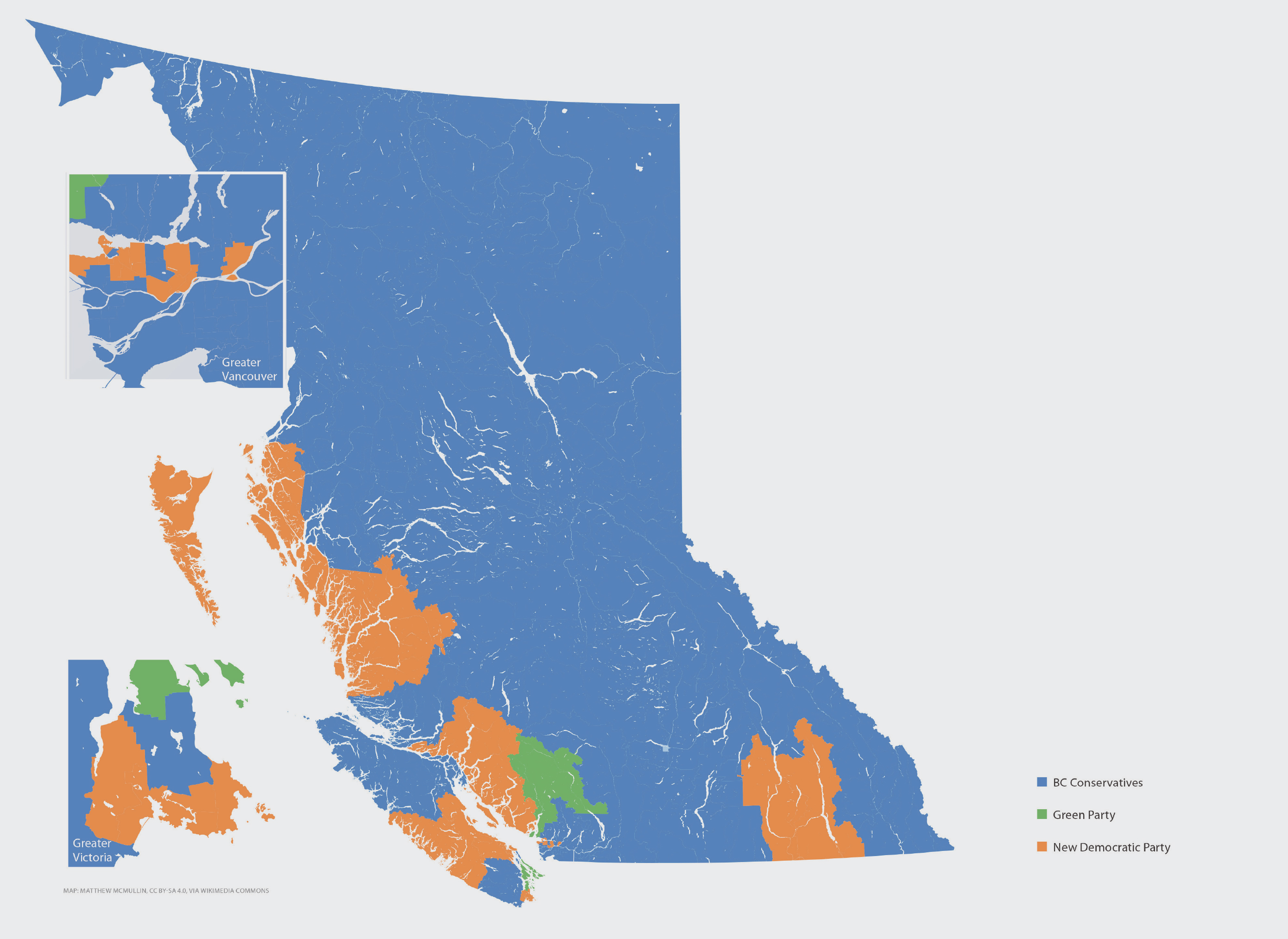
In October 2026, British Columbians voted to bring a new government into power after nine years under the New Democratic Party.
British Columbians voted on Oct. 24 to elect a new Conservative government, the first new provincial government for the province in nine years.
Heading into the election, the previous New Democratic Party (NDP) government had a narrow majority of 47 seats out of a possible 93. The official ballot count is expected to be completed by Nov. 18. At the time of this article’s writing, the new Conservative government is expected to receive a 63-seat majority.
The new government is expected to be led by MLA Lorne Doerkson, who has been thrice-elected as representative for the Cariboo-Chilcotin electoral district. Prior to politics, he spent 20 years in the newspaper industry, followed by roles in the automobile industry and financial services.
Under the previous NDP government, pharmacists received an expanded scope of practice, including the implementation of minor ailment and contraception prescribing, expanded injection authority, expanded adaptations, lab test ordering, plus a small $1 increase to the dispensing fee.
A new government, a new platform
While the new Conservative government has yet to begin its work, there are some notable items of interest to pharmacists in the new Conservative Party’s election platform. Of note, the Conservatives have promised free shingles vaccinations for seniors, stating that providing free shingles vaccines will reduce doctor visits, emergency room trips, hospital stays and long-term pain for older adults.
The Conservatives have also promised to “remove barriers that prevent qualified (health) professionals from using their full skills”, seeming to suggest that additional expansions to scope of practice may be in the future. With respect to addictions treatment, the new government-elect said it intends to “expand detoxification, clinical treatment, recovery housing and aftercare” and provide “immediate access to detox, evidence-based medications, residential treatment and outpatient programs as required.” It also aims to provide mandatory treatment for those with severe addiction, mental health challenges or acquired brain injury, who cannot care for themselves or are at risk of serious harm. For long-term care, the Conservatives are committing to reinstating $1.43 billion in funding to build seven long-term care homes.
The Conservative Party’s full platform can be found at conservativebc.ca/plan.
Several members of the new Conservative caucus have roots in health care, including a physician and a registered massage therapist, though neither are pharmacists.
Dr. Anna Kindy, Conservative MLA-elect for the North Island district, has spent 35 years in medicine as a physician and addictions specialist. Reached after the election, she said pharmacists are often among a community’s most trusted health professionals.
“Anyone who thinks a pharmacist just counts pills hasn’t been inside a pharmacy lately. Pharmacists are already assessing minor ailments, prescribing contraception, and giving the lion’s share of our flu shots,” Kindy said.
“In the communities I represent they’re often the health professional people see most and trust most. That’s not a small thing. When you’ve got a doctor shortage, the smartest thing you can do is make full use of the trained people you already have, and pharmacists are definitely on that list.”
Penticton-Summerland MLA-elect Tracy St. Claire, who served nine years as executive director for the South Okanagan Division of Family Practice, pointed to comments made during her campaign.
“I’ve worked in health care for the last 14 years, and I very strongly believe that we can’t afford another four years the way we’re going. We simply can’t afford it from a revenue and an expenditure standpoint. But working in health care, I’ve seen services decline at the same time that we have a growing demand,” she said in an interview published on Oct. 21.
“We know that we’ve got a lot of people who are getting older and need more services, and at the same time, we have fewer services available. So, working in that system, I think we can do better. I know we can do better, and I feel like I’ve got the experience and the background to help make that change.”
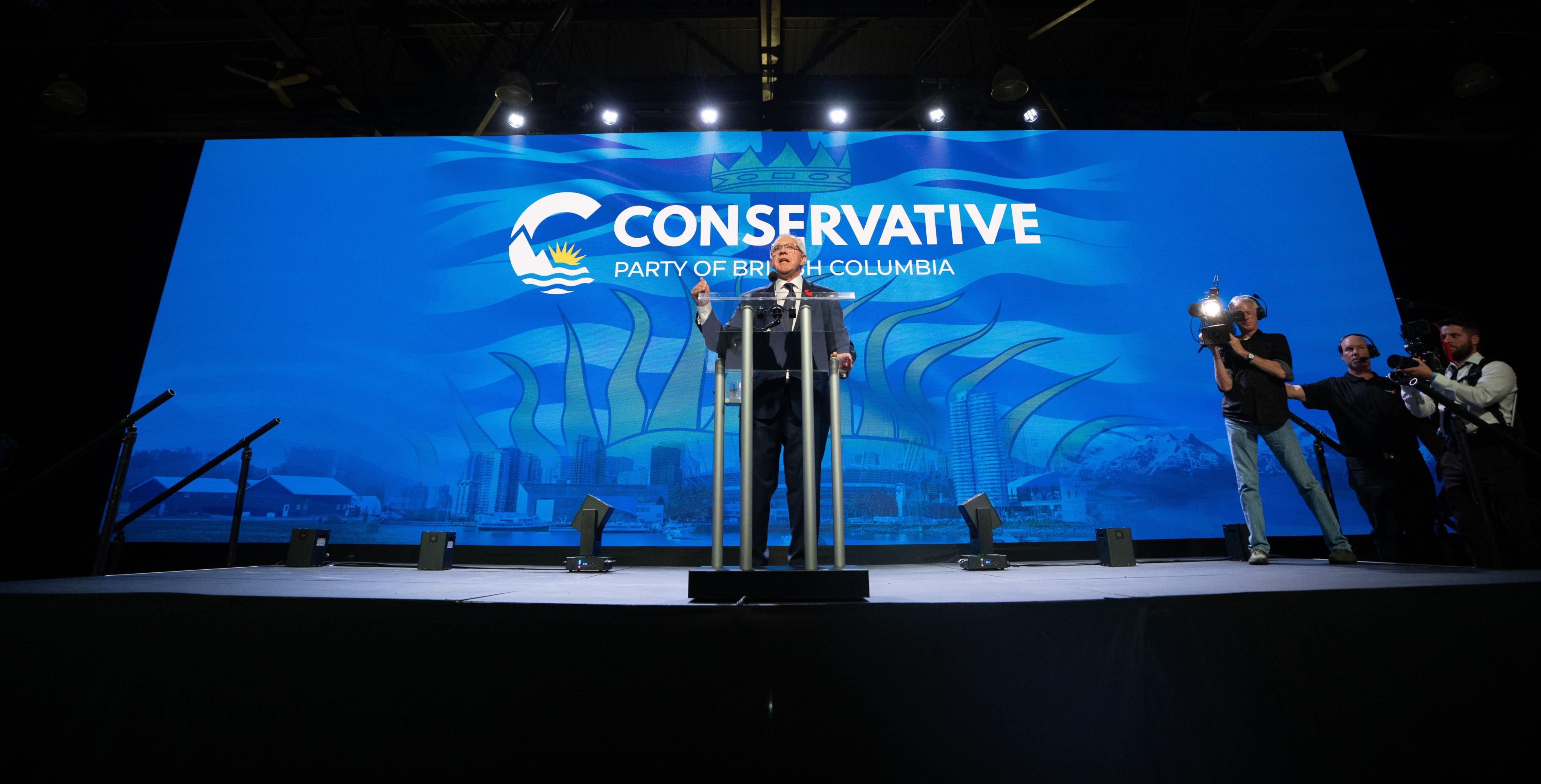
BC Conservative Party Leader Lorne Doerkson speaks on stage after polls closed on Oct. 24, 2026.
Your Association’s advocacy work during the election
In the lead-up to the election, the Association invited all candidates from five major competing parties — the NDP, Conservatives, Green Party, OneBC and CentreBC — to meet a community pharmacist in their district to learn about the profession’s work.
Despite the overlap with a busy fall vaccine campaign schedule, more than a dozen members agreed to meet a candidate in their pharmacies. Several candidates also took the opportunity to receive their flu and COVID-19 shots during the tours.
In the Association’s invitation letters to candidates, the BCPhA pointed out the significant savings pharmacists have realized since being enabled to provide minor ailment and contraception prescriptions. At $20 per minor ailments assessment for pharmacists, this compares to $35.83 for a non-longitudinal family practice clinic visit, $57.50 for a 15-minute longitudinal clinic visit, $182.50 for a Urgent Primary Care Centre visit, and $304 for an emergency department visit. This means that pharmacists are saving the provincial government anywhere from $15.83 to $284 per patient visit.
If one were to round down to a savings of just $15.83 per patient, community pharmacists have saved the province more than $15.8 million since June 1, 2023.
The Association also provided a voter’s guide to each of our pharmacist members, showing the major party candidates, their platforms and voting instructions for each of the province’s 93 electoral districts.
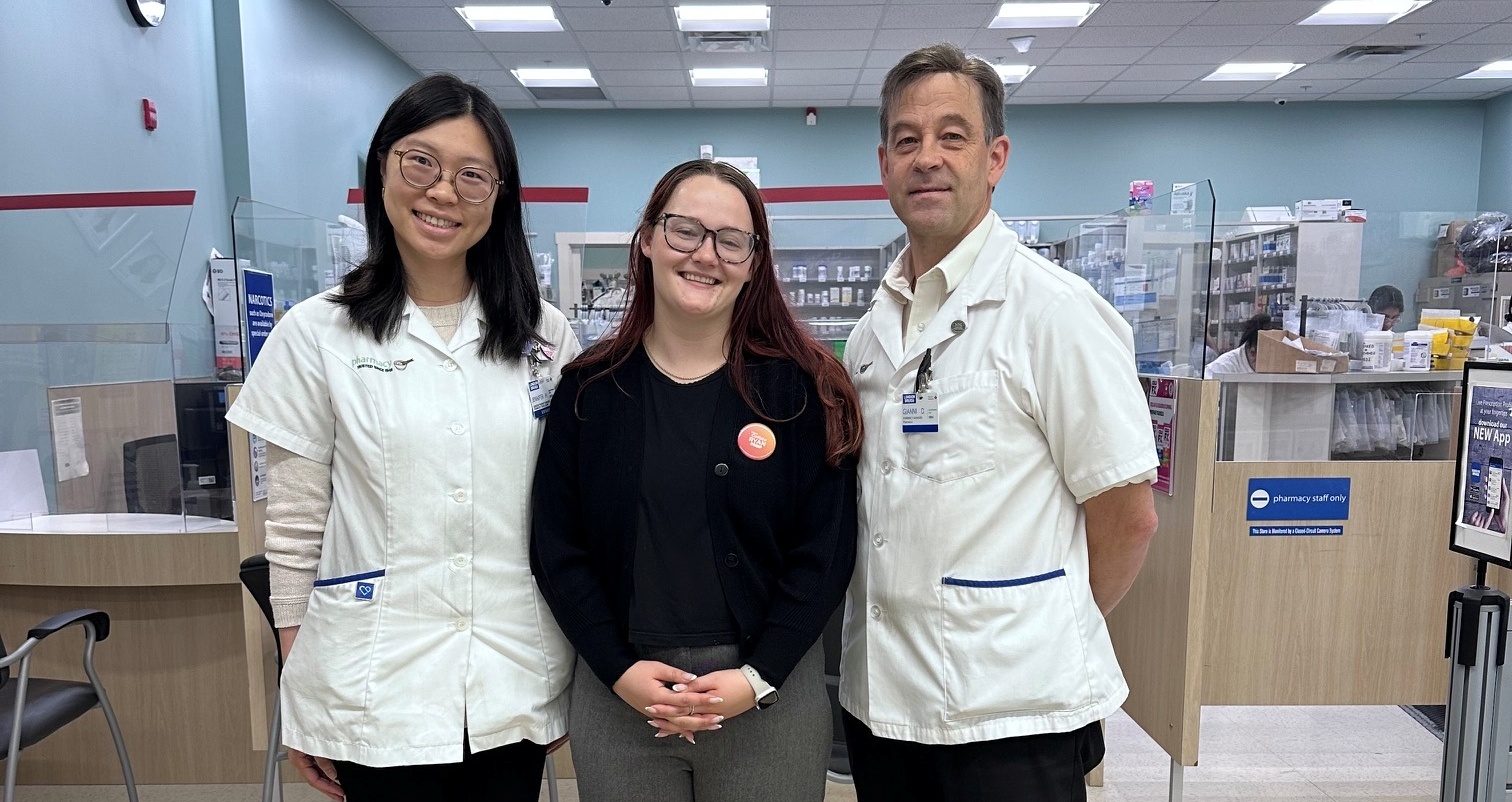
Vancouver-Quilchena NDP candidate Callista Ryan poses with London Drugs #088 Assistant Pharmacy Manager Jennifer Ho and Gianni Del Negro, Pharmacy Manager following a pharmacy tour in October 2026.
What members say
Elke Groening, pharmacy manager and co-owner of Apex Pharmacy in Abbotsford, hosted re-elected Conservative MLA Bruce Banman for a visit to her pharmacy about a week before the election. Groening said she is looking forward to learning more about a new long-term care funding model discussed during the pharmacy visit.
“For long-term care homes, there are private homes and publicly funded homes that get funding from the government. The Conservatives are exploring a model where the funding follows the patient, so potentially it could go to a privately run home and the patient would qualify for government funding to do that. It was a unique idea I hadn’t heard of before,” Groening said.
“We also talked a lot about providing care for seniors at home, which is great as we already support seniors at home through daily dispense and other services. We also discussed how previously there was funding for seven long-term care homes cut, and it sounds like that’s going to be a priority for them.”
Groening recognized that per bed fees increased under the previous government’s term, but added that more attention is needed to the sector as patient needs become more complex.
“I hope they are open to having these discussions with advocates such as the Pharmacy Association. Seniors are what our specialty is and that’s an area I hope the new government would focus on, to provide some support for seniors at home, and to avoid these long waitlists for long-term care homes.”
Greg Wheeler and Chris Pasin, pharmacy owners of three pharmacies in the Interior region, hosted re-elected Conservative MLA Donegal Wilson at his pharmacy in Oliver just prior to the election. He said the discussion during the visit ranged from hospital closures to how minor ailments have helped alleviate pressure on the system.
“We had a great discussion covering a vast array of issues in our area including water sustainability, hospital closures, and pharmacy. She had a tour of the pharmacy and we discussed services, cost savings to health care, reducing the burdens on the system, and expanding the types of minor ailments pharmacists can prescribe for,” Wheeler said.
“For example, we discussed the benefit of virtual minor ailments to help minimize ER visits, prescribing for chronic disease management in coordination with lab tests and assessments, and point of care testing and prescribing. She was very open to the discussion and appreciated hearing potential solutions to known problems in the health care system.”
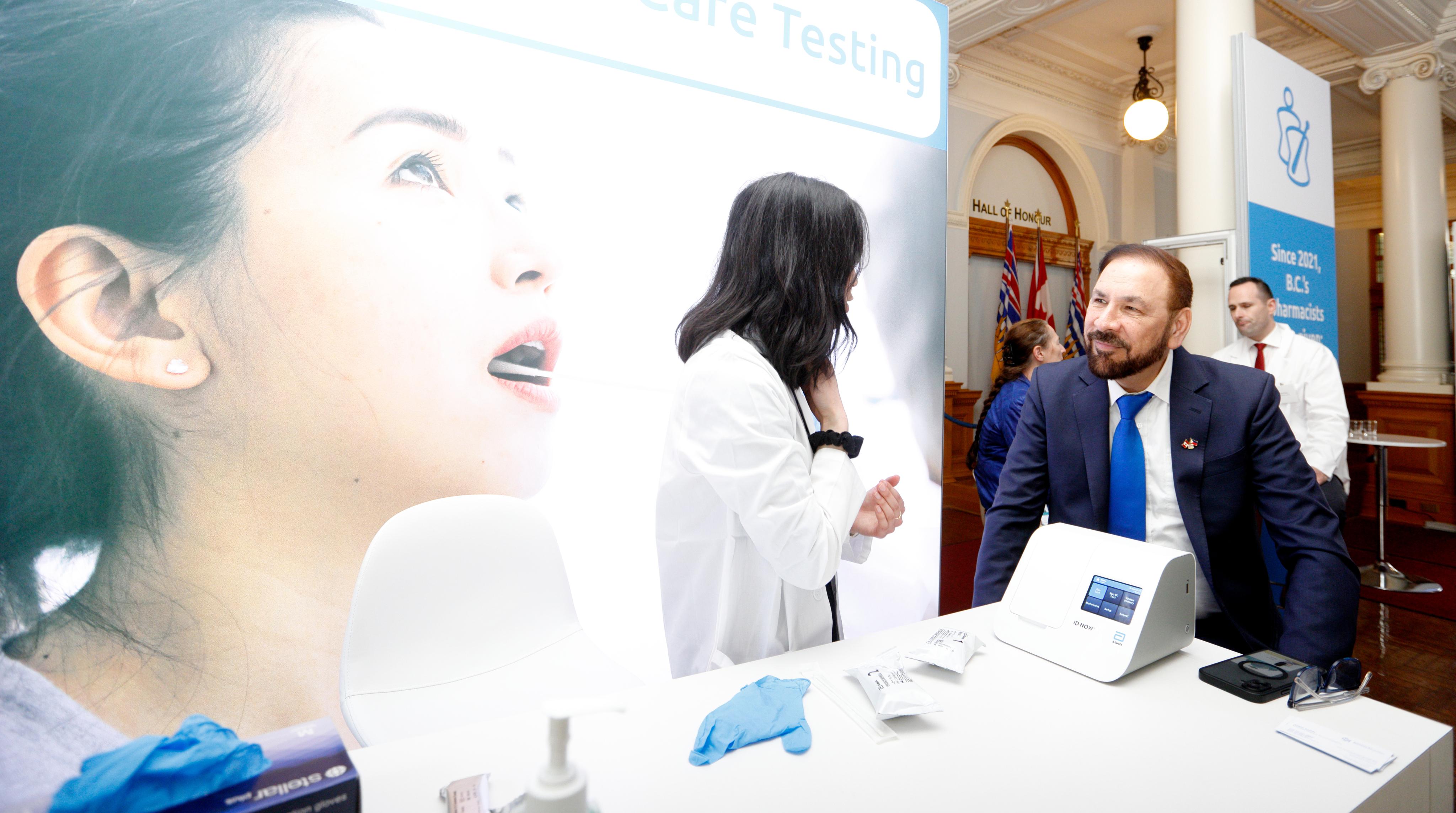
A pharmacist demonstrates the use of a point of care test device during a pop-up pharmacy event at the B.C. Legislature in May 2025.
The Association’s current asks
With an aging population, one area pharmacists can greatly assist in is the treatment of stable, chronic diseases such as hypertension and diabetes. High blood pressure, or hypertension, is among the top risk factors for death and disability in Canada, and the management of this condition by pharmacists is an intervention with one of the largest bodies of evidence to support its effectiveness in improving patient outcomes. Hypertension also increases the risk of diabetes in patients, occurring twice as frequently in patients with diabetes compared to those without. The Association has proposed that prescribing for hypertension and diabetes is logical and should be included in the list of minor ailments pharmacists can prescribe for.
Secondly, there is an ongoing missed opportunity in delaying a publicly funded strep throat testing and treatment program in community pharmacies. With approved point-of-care testing (POCT) devices, pharmacists can quickly conduct a test with the patient at the pharmacy counter, immediately provide results, and issue a prescription if one is needed.
Multiple other provinces are already providing publicly funded POCT strep tests at pharmacies, or are in the process of implementing a program, including Nova Scotia, Alberta, Saskatchewan and Ontario. Strep throat is estimated to consume 5 to 15 per cent of emergency room visits for adults, and 20 to 30 per cent for children. During a pilot project in Nova Scotia, strep throat accounted for 20 per cent of all delivered services, double the volume of other common minor ailments and demand continues to increase.
As the new government begins its work, the Association encourages its members to reach out to the Association to get involved in our advocacy program. Part of this includes introducing the new MLAs to their local community pharmacy. Doing this means political representatives will have the opportunity to observe how health care is delivered by pharmacists in the community, and to understand how policy decisions can affect day‑to‑day practice.
The Association routinely invites political representatives to take tours of their local pharmacies, often in combination with new advocacy asks.
You can see the latest list of advocacy positions from the Association at bcpharmacy.ca/advocacy/submissions.
For more information about organizing a visit from a political representative to your pharmacy, please email communications@bcpharmacy.ca.