
Practice review inspectors from the College of Pharmacists of B.C. are expected to begin asking questions about whether pharmacies have adequate staffing levels to deliver safe care during their inspections.
The announcement, made by College Registrar and CEO Suzanne Solven during a speaking session at the BCPhA 2026 Annual Conference, is the latest in a multi-year effort by the regulator to respond to reports of pharmacy business practices that could compromise safe and effective care delivery. These reports include messages from pharmacists and technicians that they feel under pressure to meet financial targets, quotas or other metrics to increase profitability.
As per section 18(2) of the Pharmacy Operations and Drug Scheduling Act in B.C., direct and indirect owners of pharmacies must ensure “staff levels are commensurate with workload volumes and client requirements are met at all times,” and that they must ensure “quotas, targets or similar measures” do not compromise patient safety or bylaw compliance.
To examine compliance, the College may be asking questions such as, what is a reasonable amount of time a pharmacist needs to dispense a day’s worth of prescriptions? How many prescriptions would that be? What other work did the pharmacist do that same day?
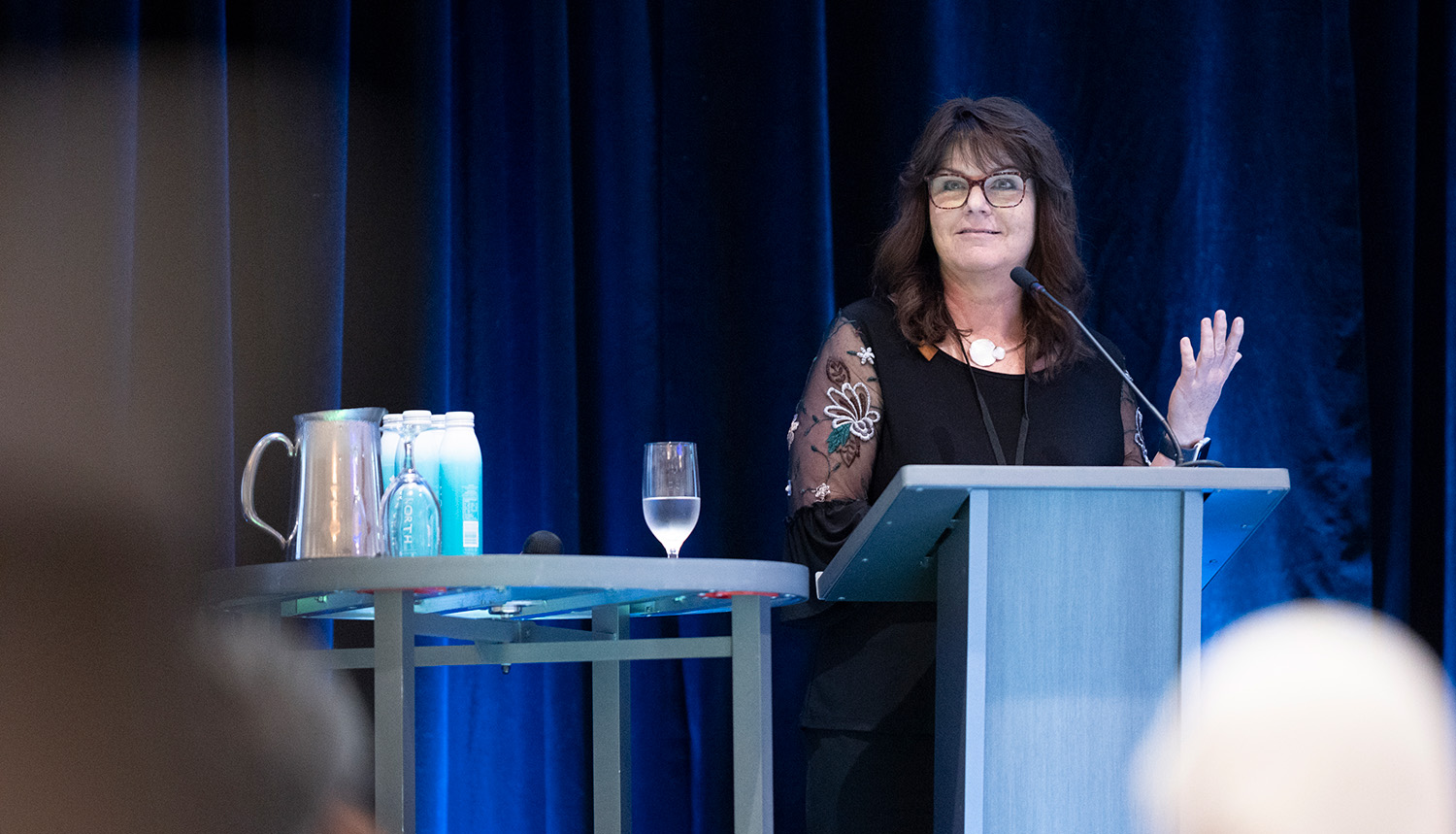
Suzanne Solven, College Registrar and CEO, spoke at the BC Pharmacy Association Annual Conference on May 2, 2026.
Solven pointed to multiple examples where the College tracked the number of pharmacists working in a pharmacy, the total number of prescriptions dispensed, plus the total number of adaptations and minor ailment consults completed.
“Our inspectors are out there, when they’re doing their practice reviews, they’re going to start asking questions about your staffing,” Solven said. “This is what we start to look for: what are the risk indicators that we know from the data we collect?”
Solven pointed to data from one pharmacy, where a single pharmacist is filling an average of 110 prescriptions per day, in addition to an average of 31 minor ailment consultations per day. She raised the question of how all that work could be done in such a short time, and suggested that the 31 minor ailment consults alone could have filled up an eight-hour day.
“I’ve asked my colleagues, on average, what would be the time frame to do a good PPMAC? And they said 10 to 15 minutes. Do the math,” Solven said.
“Another example, an average pharmacist doing 304 prescriptions a day on their own in an eight-hour day. You tell me if you think you could do that and not be burnt out and stressed out. On top of that, they’re doing PPMAC and adaptations.”
The College’s work on this topic began more than two years ago. In April 2024, the College surveyed British Columbian pharmacists and pharmacy technicians, receiving responses from nearly 2,200 people. Among the respondents, 23 per cent worked for the same pharmacy chain, and more than 30 per cent of all respondents said they experienced pressure to meet financial, professional targets and other labour-based metrics, resulting in public harm. The survey also sought to determine how many respondents were pressured or directed to provide specific pharmacy services, such as adaptations or immunizations, within a short amount of time.
In the months following the survey, the College launched a Business Pressures Tipline as part of an anonymous whistleblower program.
The worry is that when a pharmacy can’t meet its business targets, pharmacists may be asked to do more with the same or less resources, which then puts additional pressure on those pharmacists, potentially undermining quality of care, and that ultimately impacts the patient.
“So, how do we help? We have been working across the country with all the pharmacy regulators trying to figure this out,” Solven said. “Because it’s not a B.C. problem, and actually, it’s a national, international problem.”
“We continue to get tips regularly. We continue to hear the same issues, and at the top is insufficient staffing and labour cuts leading to burnout, leading to standards not being met, and the pharmacist really, really worried about patient safety risks,” Solven said.

Colleen Hogg (left) is the owner of Cove Pharmacy on Quadra Island and a Board Director at the BC Pharmacy Association. She said doctor shortages have meant her pharmacy has recently become a triage centre for her community.
Colleen Hogg, Past Chair of the BCPhA and owner of Cove Pharmacy on Quadra Island, said the College should be mindful that workload has increased significantly for the average pharmacist over the past several years.
She said today’s pharmacy dispensary sees higher prescription volumes, more patients seeking clinical services such as vaccinations, minor ailment assessments and medication reviews, and this additional workload has been compounded by an ongoing shortage of doctors.
“In our area, due to the doctor shortage, the clinics direct everyone to us even when we are unable to help with their prescription, which means we spent a lot more time explaining why we can’t provide a service. The patients don’t understand, because the ‘clinic’ told them we can help them. People are using us as a triage or walk-in to see whether they need to go to the emergency room,” Hogg said.
These conversations, where a community member might pop in, ask a question and leave without receiving a service, takes time, and make tracking how busy a pharmacist’s day is not just a question of numbers of dispenses, or services provided.
“One day you can fill 150 scripts in a shift and feel relaxed, the next, you feel like the day was chaos and you only did 60,” she said. “A single practice review provides only a snapshot of daily operations. Staffing adequacy is difficult to assess without seeing the full picture — does the pharmacy prepare and fill prescriptions before or after opening to the public? What technology do they use to help reduce labour?”
Hogg said expanded scope has also resulted in additional administration and documentation work, all of which adds up to the individual pharmacist taking on additional workload, often with the same staffing level as they traditionally had. Furthermore, rural pharmacies often have difficulty attracting more staff, and often hiring efforts are unsuccessful.
“My concern is that staffing decisions are complex and may not be accurately judged during a brief inspection without considering long-term operational data.”
Andrew Low, a BCPhA director and Western Canada Pharmacy Director for Neighbourly Pharmacy, said one of his stores in Burns Lake has already undergone a College practice review, with staffing and workload as the focus of the visit.
“It was about two months ago, there was no warning. Usually we will get a notice a couple of weeks or a month ahead if they’re coming to a pharmacy,” he said. “They came in and interviewed all the staff at the same time, asking about workload, script level, dispensing activities, stress and burnout. Each of the staff were brought into a room and interviewed individually.
“I think more than anything the staff were surprised and stressed. They didn’t know what was happening.”
Low said integrating clinical service work into a traditional, dispensing community workflow is something many teams are still figuring out. His concern is particularly for pharmacy teams working in rural areas, where staffing levels may be lower and relationships with patients are closer.
“For me, the guiding principle is who is the practitioner, and are there any sort of indicators where there is burnout or risk to public safety? Some of those indicators could be, for instance, error reporting, which is now a requirement from the College’s CIRCL program,” he said.
“If we see an increase over and above what normal error reporting is, we might want to step in and ask what some of the causes of that are. Another indicator we have is our monthly check-ins with staff. Each district director will talk with the manager as well as the district team and try to see if there are any insights from the field.”
Low said rural pharmacies are more adversely affected by a lack of prescribers. When there are no prescribers and only one or very few pharmacies in a rural community, those pharmacies bear the full brunt of the health-care demand, while patients in an urban area will almost certainly have other options.
“I would hope the inspectors have some sort of connection with rural pharmacists, that they have experienced a pharmacy and a pharmacy workflow in some capacity before. I think it’s difficult to come and be an objective observer of a pharmacy, unless you have that depth of experience,” he said.

BCPhA Board Director Andrew Low's concern is particularly for pharmacy teams working in rural areas, where staffing levels may be lower and relationships with patients are closer.
Mark Kunzli, another BCPhA Board Director and pharmacist, said staffing shortages had him covering three pharmacies in the same week, in Merritt, in Sidney on Vancouver Island, and in Surrey. Two of them would have had to close without the coverage, he said. A concern he has is that putting a limit on the amount of work a pharmacist can do may further aggravate staffing shortages.
“Measuring a pharmacist’s workload by prescription count does not make a lot of sense to me. Filling 12 medications for one patient is a lot different than one medication for 12 patients. Earlier today, I processed about 300 prescriptions for 30 blister pack patients. The packaging and product check is done at our central fill facility, then we do the final check in the pharmacy,” Kunzli said. “If those 300 prescriptions mean I have already hit my capacity limit, a lot of patients aren’t going to get their medications filled. If you’re in a town with only one or two pharmacies, where are they going to go? These aren’t just numbers, these are patients.”
He suggested if limits to prescriptions or services per day were to be put in place, rural pharmacies must be exempted from them.
“Pharmacies throughout the province are already struggling. The College needs to come to the table and help us advocate for funding, and also look at how much administrative burden its own requirements add to a pharmacist’s day. I understand the College is focused on patient safety, but if there are access issues in rural communities because there are not enough pharmacists, better funding and less paperwork will improve patient safety,” Kunzli said.
Solven, the College registrar, emphasized that every practice is different, and every pharmacist is different. Some pharmacists work at a faster pace. She said how a newly graduated pharmacist practices compared to a multi-decade pharmacy veteran will be different. Some tasks in the pharmacy are more simple, while others are complex, and that the College recognizes these factors and their need to be flexible.
Solven said that the College recognized meeting business targets is crucial to ensure pharmacies stay afloat, that any regulation must be done with the “right touch”. She said the College wants to balance regulation and business practices, but the right level of balance is yet to be determined.
“We don’t want to over-regulate so that pharmacies start shutting because they can’t manage anymore,” Solven said.
“But at the same time, we have to ensure from our perspective, if we (the College) get audited by the people that can regulate us, can we show that we’ve done our due diligence and our job to protect the public?
“So it’s going to be this balance, and I look to all of us within the profession to figure out what the right balance is.”